
ITSM Automation: Where Deterministic Workflows Beat Scripted Runbooks
An access provisioning runbook fails at step four of seven. The directory account already exists. The group memberships never applied, and the ticket in your queue still reads "in progress." Nobody on the desk knows whether rerunning the script fixes the request or creates a duplicate account. Multiply that uncertainty across a month of access requests, and you have one reason IT service management (ITSM) automation programs stall well short of the coverage their business case promised.
ITSM automation uses workflows, rules, and AI to handle incident, request, change, and access processes with as little manual effort as the risk allows. Many teams start with the scripted runbook: a documented procedure converted into a script that runs after an alert, on a schedule, or when a fulfiller clicks a button. Deterministic workflow engines do the same work on a different architecture. That architecture decides whether the automation survives an audit, a policy change, and AI agents running at ticket volume. This article tests both approaches against those three pressures.
Where Scripted Runbooks Break Down
Scripted runbooks break down because each one encodes what a single engineer knew on the day it was written. Nothing in the design updates that knowledge. The script keeps running, or keeps appearing to run, while the systems around it move on.
Drift is the first failure mode. A script drifts when it outlives the API, endpoint, or security rule its author built it against, and it may fail only when a rarely used path finally runs. Teams often find the problem only after comparing the script's age with the systems it now touches. Brittleness compounds it. A runbook covers the scenarios its author imagined, and a late-night outage may follow one they didn't.
Staff turnover makes both worse. Knowledge walks out, and undocumented assumptions leave with the author. The on-call engineer who hits a failure in a system another team owns may have one option: page that team and wait.
Automation also changes the work people keep. Automate the easy parts, and what's left for humans gets harder, so the operators you keep need more skill. Many organizations deskill them instead. Managers tell people to run the runbook. When it fails, they have nothing else to run.
Audits expose another weakness. Scripts often carry embedded service account secrets, and their logs contain only what the author chose to record. Reconstructing who ran a script, with what input, and what it changed can be difficult or impossible. In a script, auditability exists only where someone built it.
Partial success is the quietest failure. A job exits cleanly after finishing half its steps. Nobody learns which half until the next access review.
What Makes ITSM Automation Deterministic
A deterministic workflow applies the same rules and branches every time it receives the same input and observes the same state, and it records the path it takes as it runs. Branching on recorded conditions keeps the workflow deterministic. For access, change, and incident processes, that property gives you an audit trail on demand. Without it, you stitch one together from log fragments and hope it's complete.
Deterministic and probabilistic systems execute work differently. Deterministic logic follows explicit rules: if this condition, then that step, every time. Probabilistic systems, including large language models (LLMs), interpret a goal and select a likely response or path, so the same input can produce a different output on another run.
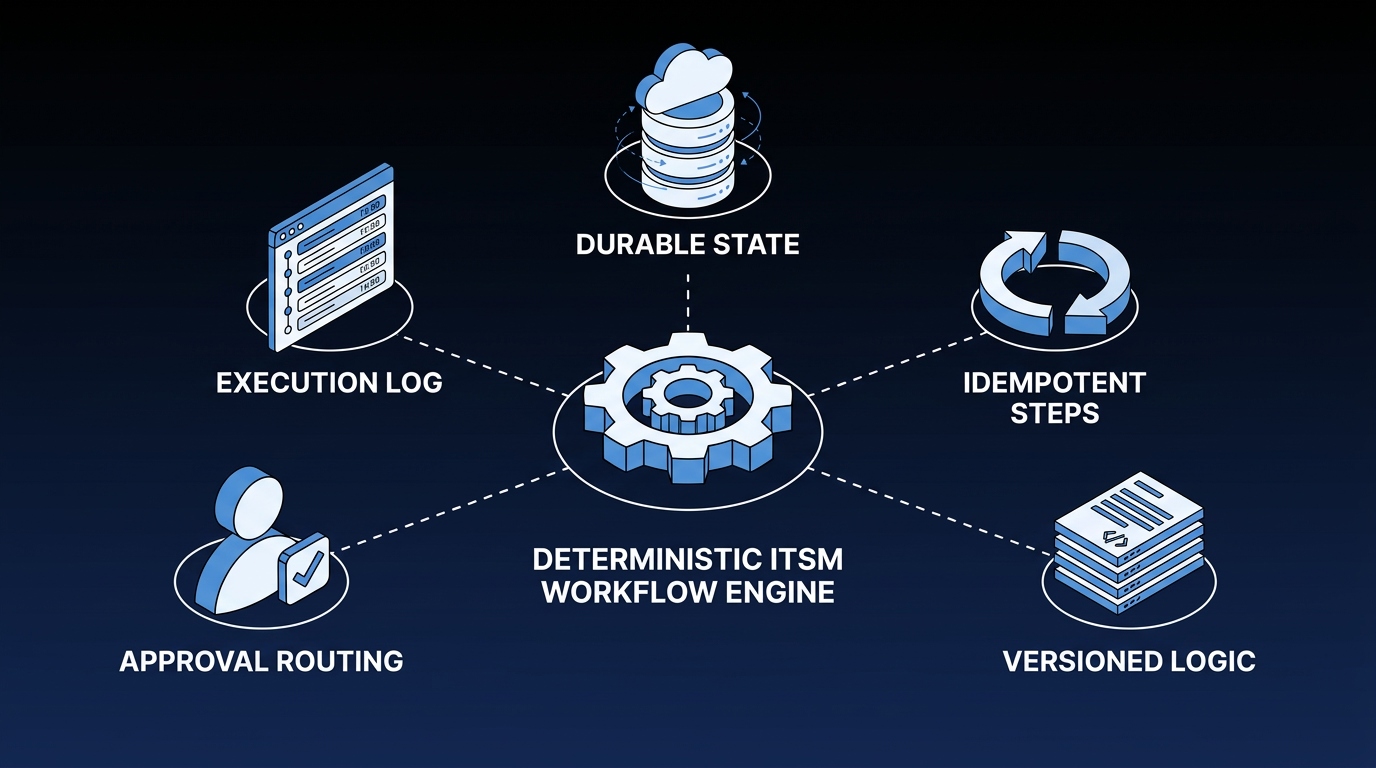
A workflow engine puts deterministic process control in charge of the sequence. It provides five controls that script authors would otherwise have to build and maintain themselves:
- Durable State: The engine stores execution state outside the running process. A run that fails at step four resumes at step four, with no second account and no ticket stuck in an unknown state.
- Idempotent, Retryable Steps: An idempotent step produces the same intended result however many times the same request repeats. A stable identifier stays constant across retries and unique across runs, so the engine and the target system can recognize a retry and skip the duplicate account or orphaned permission.
- Versioned Logic: When the change policy updates mid-quarter, requests already in flight finish under the definition they started with. New requests run under the new one, and each instance records which version applied.
- Approvals and Exceptions in the Definition: A human approval gate is a step in the process. The engine records the approver's identity separately from the identity of whoever started the run, and it sends exceptions to a named reviewer.
- A Structured Execution Log: Every step, input, output, and timestamp lands in a queryable record as a byproduct of execution. Nobody has to remember to write logging code.
A script can implement all five, but its authors must design, test, and maintain each one. Durable state and idempotency answer the half-finished provisioning run. Approval routing and the structured log answer the two questions an auditor asks first: who authorized this, and under which policy?
Versioned logic has one limit. It preserves the policy applied to in-flight work, and an obsolete API call still needs someone to update it.
Where AI Agents Belong in ITSM Automation
AI agents belong on the steps that need interpretation. They can read a free-text incident, classify a request against your service catalog, pull the right approver out of a policy document, or draft the resolution note. The sequence belongs to the engine, because LLM output can vary between runs.
That variability can persist even under settings intended to reduce randomness. An agent that resolves two identical access requests differently leaves no reproducible decision trail. Picture an agent that misreads a policy and grants excess permissions. The error becomes a security event, and it can repeat at ticket volume before a quarterly access review catches it.
AI fails most often in auto-remediation, self-healing infrastructure, and agent-led management of workflows within and between systems, according to a Gartner survey of 782 infrastructure and operations (I&O) leaders. The last category puts an agent in control of the sequence.
Governance sets the limit. "Written corporate policies cannot physically stop an agent from making a destructive error," says George Spafford, a vice president analyst, in Gartner's agentic AI governance guidance. The recommended controls treat each agent as a distinct identity with least-privilege, temporary access. They also keep AI reasoning separate from execution: the agent proposes an action, and a separate control layer evaluates it before anything runs.
By 2029, at least 70% of organizations running production agentic AI in I&O will experience a material service, security, or cost incident linked in part to insufficient runtime controls, according to the same analysis. In ITSM, the deterministic workflow engine is that control layer. The workflow definition decides which agent runs on each step, which permissions it receives, and whether a human-in-the-loop approval sits between the agent's recommendation and the directory change.
Identity, policy, logging, and approvals are engine controls you configure alongside the deterministic sequence. They grow more important as agents absorb more volume, because every ungoverned decision runs at machine speed. Skip them, and you get AI agent sprawl: dozens of agents, each with its own permissions and no shared record.
Why Deterministic ITSM Automation Wins the Budget Review
Deterministic ITSM automation wins the budget review because it produces audit evidence as a byproduct and calls a model only where a step needs one. The architecture shows up on the invoice.
Only 28% of AI use cases in I&O fully succeed and meet return on investment (ROI) expectations, and 20% fail outright, according to the same Gartner survey. Success concentrates in ITSM, where 53% of I&O leaders reported their AI wins. Among leaders with AI success, 33% embed AI into the systems and processes people already use. The wins come from AI running inside a governed process.
Audit evidence makes the first part of the budget case. Sarbanes-Oxley (SOX) IT general controls cover logical access, change management, and IT operations. ISO/IEC 27001 controls address change management, logging, and segregation of duties. Auditors typically want to see who requested a change, who approved it, who reviewed it, and whether those actions happened in the required order.
A runbook answers with whatever its author chose to log. A deterministic engine answers with the execution record it produced anyway.
Pricing strengthens the case. Enterprise software vendors are adding consumption pricing and agent-interaction metrics alongside per-seat models, and under consumption pricing the AI line grows with adoption. A deterministic engine skips the model call on steps that don't need one. Per-application pricing keeps the platform fee predictable, though model costs still scale with the calls each process makes. The savings come from calling the model less.
High-volume requests make the case strongest. Well-defined password resets and similar requests follow identical steps every time, and deterministic rules run them at lower cost and with fewer failure paths than routing each one through an LLM. Automate those first. The desk's remaining volume is the ambiguous work, where interpretation earns its cost.
Sanofi, which builds its AI workflows with Elementum's Workflow Engine directly on its data lake, has set an 80% target for AI agents resolving employee IT support requests autonomously. A target at that scale depends on the agent budget going to tickets that need reading.
Deterministic ITSM Automation Before AI Agents Scale
Deterministic ITSM automation has to come first, and the order of operations decides more than most roadmaps assume. Put AI agents on runbooks, and the agents inherit runbook drift, silent partial success, and missing audit trails, plus a new layer of probabilistic decisions. Make the engine deterministic first. Configure identity, policy, logging, and approvals next. Every agent you add afterward becomes a governed step.
We built Elementum as an Enterprise AI Apps Platform that replaces the application and retires the licensed system. We can replace the service request and incident management modules running in ServiceNow, with request and case resolution running across your existing configuration management database (CMDB) and identity systems. Many of our customers start with one workflow, prove the savings, and expand into adjacent processes, and the estate gets smaller as each module moves.
Our Workflow Engine treats humans, business rules, and AI agents as equals, and the engine sequences every step. Our AI Agents handle the steps that need reasoning, and we run your existing agents inside the process. Configurable decision thresholds set where an agent acts on its own and where it escalates. We log every agent action.
We run natively inside your own cloud data platform, including Snowflake. Databricks is a live second track, currently a minimum viable product (MVP). Workflows query source systems in place under your existing access controls. Our Zero Persistence architecture retains nothing after the run, and we never train on, replicate, or warehouse your data.
Your models, your data, your data platform, and your interface stay yours. The license is a flat annual fee per application, with no per-seat license, no per-conversation charge, and no per-action charge for AI.
Global enterprises including Sanofi, Under Armour, and Elevance Health run on Elementum.
Contact us to map governed agentic AI into your ITSM architecture and the rest of your AI roadmap.
ITSM Automation FAQs
These are the questions IT and operations leaders most often raise when they weigh deterministic ITSM automation against scripts and AI agents.
What Is ITSM Automation?
ITSM automation applies workflows, rules, and AI to incident, request, change, and access processes so routine work completes with minimal manual effort. The mature form runs each process end to end. Deterministic logic governs the sequence, and AI agents handle the steps that need interpretation.
Which ITSM Processes Should You Automate First?
The ITSM processes to automate first are high-volume requests that follow identical steps and have predictable outcomes. Password resets, account access restoration, software provisioning, and onboarding and offboarding all fit. Deterministic rules can run these alone, which shows value quickly and frees your service desk for ambiguous tickets.
How Does ITSM Automation Compare With Runbook Automation and RPA?
ITSM automation, runbook automation, and robotic process automation (RPA) differ in where the process logic and state live. Runbook automation executes scripted IT procedures triggered by alerts, schedules, or an operator, and its state lives inside the running script. RPA uses bots that mimic human actions on user interfaces. A deterministic workflow engine runs business logic through native integrations, keeps durable state across steps, and records every action as it executes.
Will AI Agents Replace Your IT Service Desk?
AI agents will change what your IT service desk spends its time on. They can take a large share of Tier 1 volume, especially requests that need classification or free-text interpretation before a fixed process runs. Keep human analysts in the path for identity verification, access changes, security-policy edits, and destructive operations. A probabilistic misread there carries consequences no deflection rate offsets.