
Appian Alternatives for AI-Native Workflow Platforms
Every workflow platform decision in 2026 turns on where the workflow actually runs and what happens to enterprise data while it runs there. For teams evaluating Appian, that question sits alongside three others: what the published Standard, Advanced, and Premium tiers cost once AI usage scales, how much a proprietary process model costs to unwind at exit, and how production-ready Appian's newer agentic AI features are under real load.
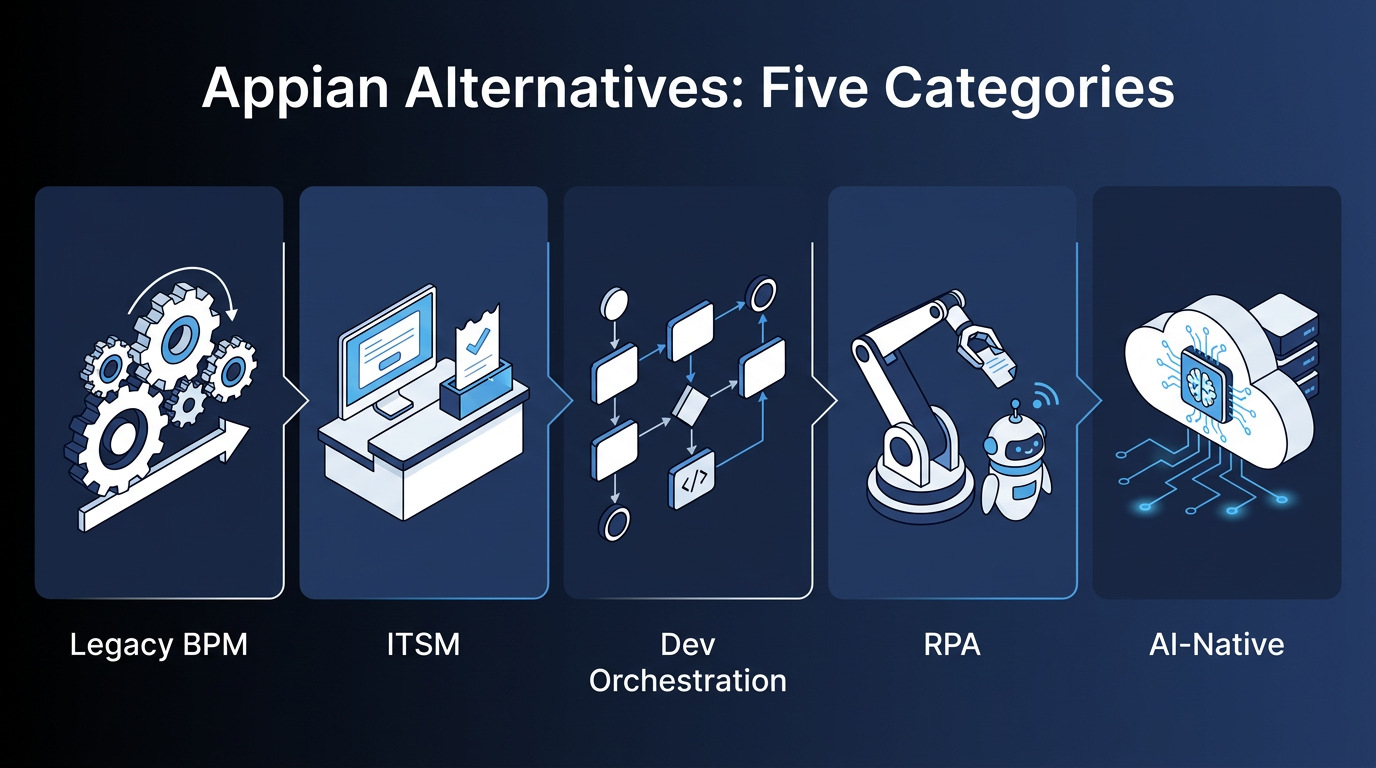
The alternatives split into five categories: legacy business process management (BPM) and low-code platforms, IT service management (ITSM)-anchored suites, developer-centric orchestration engines, robotic process automation (RPA)-derived suites, and AI-native application platforms that run processes inside a company's own cloud data platform. This article covers why enterprise teams look past Appian, how those five categories compare, and what changes when the workflow layer moves into your own data environment.
Why Enterprise Teams Evaluate Appian Alternatives
Four factors recur across enterprise Appian evaluations: pricing that scales with AI usage, exit costs tied to proprietary architecture, the production maturity of newly added agentic AI, and the specialized skills the platform demands. Each can compound as AI usage grows.
Per-User Pricing Adds Metered AI Exposure
Appian's published pricing structure organizes access into Standard, Advanced, and Premium tiers. The tiers include a different monthly allowance for AI Actions, the unit Appian uses to meter AI usage, and Appian doesn't publicly disclose overage pricing once a team exceeds its allowance.
The subscription is only the starting cost. Teams still have to build the workflow.
First-year total cost of ownership frequently exceeds the subscription price once rollout, integrations, and support are added, and reviews on Gartner Peer Insights have called for more pricing flexibility than a model based solely on user count.
Proprietary Architecture Raises Exit Costs
Appian uses its own definitions for interfaces and process models. Migration to another platform can mean rebuilding those assets rather than porting them, since they weren't built to run directly in another vendor's environment.
Recently Added Agentic AI Needs Production Testing
Appian introduced Agent Studio relatively recently. It has since added multi-agent communication, connections through the Model Context Protocol (MCP), and support for external model providers.
Because the agentic feature set is new, evaluators should test it under production loads and controls for their own processes before committing. A product catalog can't show how these features perform in a given environment.
Specialized Skills Increase Staffing Costs
Verified Appian reviews on Gartner Peer Insights describe a demanding learning curve for the platform's advanced features and expression logic, and note that advanced deployments sometimes require developers who specialize in Appian. That talent adds to licensing and professional services costs on top of the subscription, and a platform that requires its own developer discipline adds a hiring problem to a licensing one.
How Appian Alternative Categories Compare
Some Appian alternatives improve on one complaint while preserving parts of the underlying model. They may still operate as a separately licensed workflow layer connected to existing systems or meter AI usage. The category you choose determines which trade-offs you keep.
| Category | Representative Platforms | Where They Fit |
| Legacy BPM and low-code | BPM and low-code suites | Decision-rich, regulated, high-volume processes; enterprise app development |
| ITSM-anchored | Service-management suites | Service workflows, with agent management and governance features |
| Developer-centric orchestration | BPMN workflow engines | Engineering teams that want open-standard, Business Process Model and Notation (BPMN)-based agentic orchestration |
| RPA-derived automation | Desktop and task automation suites | Task-level automation and contained productivity-suite automations |
| AI-native application platforms | Elementum | Replacing the application itself, with processes running inside your own cloud data platform |
Elementum's AI-native enterprise application platform coordinates human decisions with deterministic logic and AI reasoning. It runs inside your own cloud data platform. Legacy BPM focuses on decision-rich process automation. ITSM-anchored suites focus on service workflows. RPA-derived suites focus on task-level automation. Developer-centric platforms emphasize BPMN-based agentic workflows built around process standards. Each category strengthens one dimension. Depending on deployment, these platforms can still operate as a separate licensed workflow layer alongside the systems they automate.
Elementum's AI-native enterprise application platform starts from a premise of replacing the application itself. A deterministic Workflow Engine sequences the steps. It calls AI agents where reasoning is required and executes automated logic where it is not. It then routes exceptions and approvals to the people who own them.
Elementum runs natively inside your Snowflake tenant, with Databricks available through a live minimum viable product (MVP) track. CloudLinks query source systems in place, under your existing access controls, and the Zero Persistence architecture retains nothing at the execution layer once a run completes. Where a system of record stays in place, Elementum replaces the application running the process and connects to it through APIs, rather than adding another workflow layer on top.
What AI-Native Architecture Changes for Cost and Governance
Architecture affects how much work it takes to produce an audit trail. It also shapes costs after signing and how much teams spend on AI. Only 28% of infrastructure and operations AI use cases fully succeed and meet ROI expectations, according to a Gartner survey of 782 I&O leaders.
Deterministic Backbones Keep Agents Within Reasoning Steps
Variable outputs make it harder for auditors to compare results against a fixed control baseline. They do not eliminate auditability. Teams can still use consistent logging, policy checks, approvals, and review to reconstruct what happened. Traditional automation is deterministic: if X happens, do Y, every time. An AI agent interprets a goal. It then decides how to achieve it, so the same input can produce different outputs.
For example, an AI agent may extract terms from a supplier contract. Deterministic rules and human approvals can then control payment release. This separation uses AI for interpretation without giving it sole control over the payment decision.
A finance workflow that has to pass a SOX audit needs consistent, reviewable controls. That is why AI agent determinism should sit at the center of any Appian alternatives evaluation.
Ungoverned agents can multiply, and an unlogged agent action leaves no record to audit. The EU AI Act imposes event-recording and traceability requirements on high-risk AI systems, requiring automatic logs over the system's lifetime for exactly this reason (Article 12, EU AI Act). A governed deterministic workflow can make logging and review easier than unconstrained agent execution.
In-Place Queries Retain Nothing Between Runs
Where the process executes influences what teams must negotiate at contract exit. Appian describes its data fabric as a virtual layer that can connect enterprise data without requiring all of it to move into the platform. Its cloud data platform integration similarly positions Appian as an orchestration layer connected to the data platform. AI-native execution goes further when the process itself runs inside your own cloud data platform tenant. It retains nothing at the execution layer between runs.
That architecture can avoid working copies and staged data, including a vendor-held store used to execute workflows. Teams would otherwise need to address that store at contract exit.
Elementum's CloudLinks query data in real time. Snowflake is the primary route, while Elementum offers Databricks through a live MVP track. Elementum inherits your existing Role-Based Access Control (RBAC) and Active Directory rather than rebuilding them. Every query therefore operates within the permissions your security team has spent years tuning. The models are pluggable, and the data remains in your tenant. This design makes it easier to switch models, data, cloud data platforms, or interfaces independently.
Flat Application Pricing Avoids Adoption-Based Fees
AI inference costs can rise as agentic workflows make more model calls. Under per-user licensing with monthly AI Action caps, costs can also rise as adoption expands and processes make more agent calls.
Elementum charges a flat annual fee per application, with no per-seat, per-conversation, or per-action AI charge. The deterministic engine does not call a model for a step that does not need one. For steps that do, it routes the work to a model appropriate to the task. It does not default to the most expensive one available.
How Elementum Changes the Appian Alternatives Decision
Some evaluations of Appian alternatives end in a platform swap that retains per-user or usage-based cost exposure. Licensing determines how adoption affects cost. Workflow logging and approval controls determine how readily teams can reconstruct agent actions. As inference costs and AI logging obligations grow, the architecture you choose now shapes both costs and compliance work.
Elementum's AI-native enterprise application platform is our answer to the Appian alternatives question: the AI-native replacement for legacy SaaS. We pair the deterministic Workflow Engine with AI Agents, configurable decision thresholds, and human-in-the-loop checkpoints. We log every agent action and let authorized operators revoke it. Processes run as AI-native applications inside your own Snowflake tenant, with Databricks available through a live MVP track, and our Zero Persistence architecture.
Many of our customers start with one workflow, prove the savings, and expand into adjacent processes. We have the production track record for replacing legacy SaaS at enterprise scale, with named customers including Sanofi, Under Armour, and Elevance Health.
Contact us to map the replacement path into your architecture and the rest of your AI roadmap.
FAQs About Appian Alternatives
These are the questions enterprise IT and operations leaders most often raise when evaluating Appian alternatives. Pricing, lock-in, and AI-agent maturity distinguish the field, and those differences affect long-term operating cost, migration risk, and production readiness.
Which Appian alternatives should your team consider?
A mix of major enterprise software, low-code, service-management, and process-automation platforms appears in Gartner's alternatives listing for Appian. Elementum is an AI-native enterprise application platform that replaces the application itself and runs inside your own cloud data platform.
What should you expect Appian to cost?
Appian doesn't publish dollar figures; its pricing structure uses Standard, Advanced, and Premium tiers with AI Action allowances that vary by tier. Rollout and support can increase first-year costs.
Why might your company switch away from Appian?
Beyond questions about how recently Appian added agentic AI, verified Appian reviews cite concerns including licensing costs, performance issues with complex applications or enterprise-scale data volumes, and a steep learning curve. Cost and technical fit can influence enterprise evaluations, as can migration flexibility.
Keep Reading
7 Top Coupa Alternatives in 2026

Top n8n Alternatives for Enterprise Workflows in 2026

9 Best Palantir Alternatives for AI Agent Orchestration in 2026
7 Pega Alternatives for AI-Native Workflow Orchestration in 2026

8 ServiceNow Alternatives for Enterprise Automation in 2026
9 Best UiPath Alternatives in 2026