
The Bundle Is Breaking
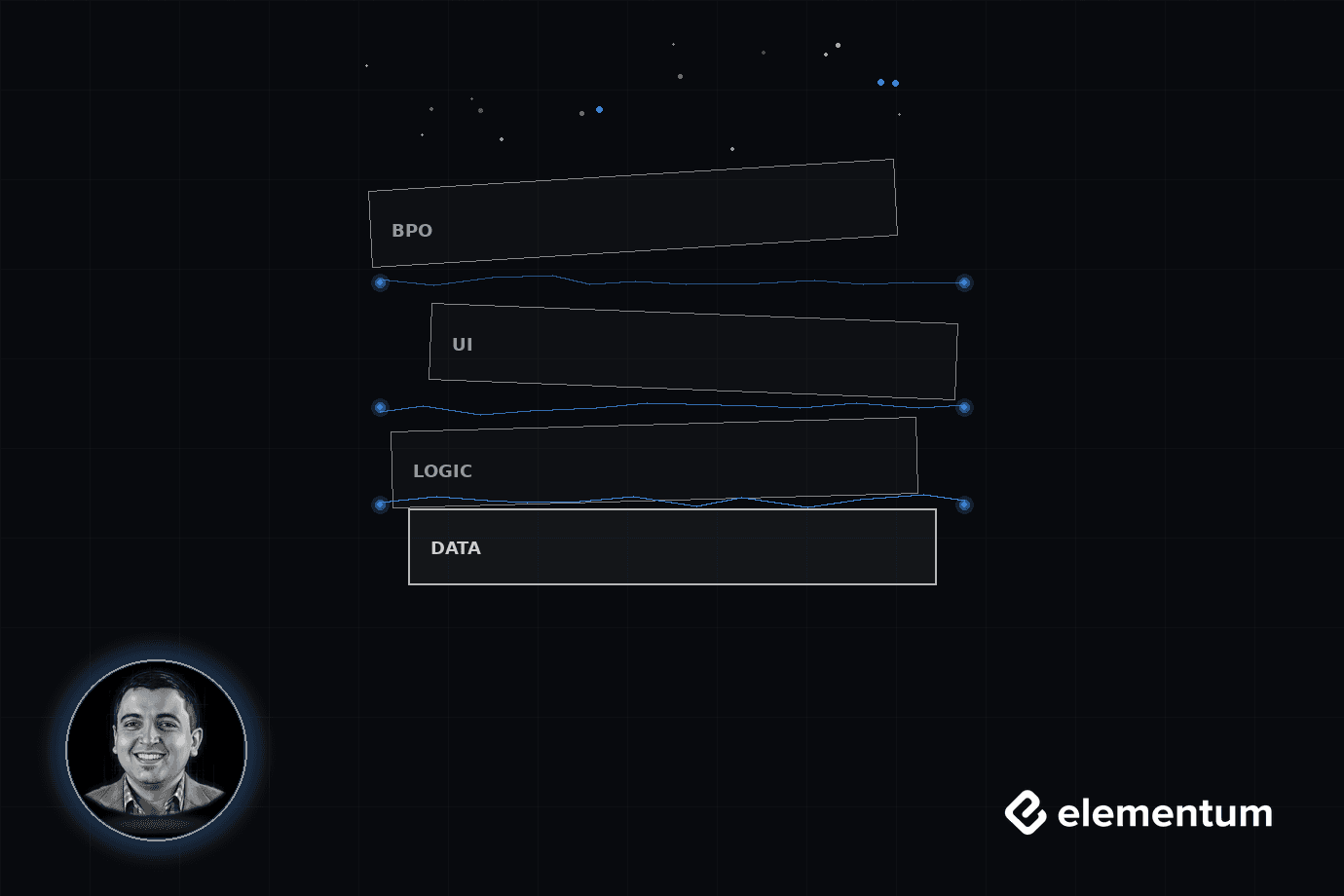
Every legacy enterprise app you bought in the last fifteen years is four things stacked together.
Three you bought from the vendor. The fourth you had to staff yourself.
It's a database. It's a logic engine. It's a user interface. And — because the whole stack was designed assuming humans would push the buttons — it's a workforce. An army of outsourced operators keying in the invoices, processing the tickets, routing the requests, working the exceptions. The system was built for them.
ServiceNow does this. Workday does this. Salesforce does this. Veeva does this. Coupa does this. The bundle was the product, plus the army you had to hire to make the product actually work. Pay one vendor, get one stack, run one function — and quietly outsource the operating cost to a global services firm so it shows up on a different invoice.
That deal is over. The bundle is breaking. And once it breaks, the per-seat economics that built these companies don't survive. Neither do the BPO contracts that were holding the whole thing together.
Four Layers, One Trench Coat
Strip a legacy SaaS app down and you find four things stacked on top of each other.
A BPO layer where outsourced humans do the actual work the system requires.
A UI layer where those humans — and your employees — click buttons and fill in forms.
A logic layer where workflows run, approvals route, business rules execute.
A data layer where everything is persisted.
For two decades, vendors charged you for three of those layers as one product. The fourth — the workforce — they pushed off the license invoice and onto a separate services contract. The license was the visible cost. The BPO contract was often the larger one.
The bundle was never about engineering. It was about pricing power, plus the assumption that human labor would always be cheap enough that nobody would do the math on the total.
What's Happening to Each Layer
The BPO layer is collapsing
This is the part the legacy vendors really don't want you to think about. For every dollar of license spend on a ServiceNow or Coupa or Workday, large enterprises typically spend another one to two dollars on the operations team that runs it. Those people exist because the system was designed to need them. When AI can interpret the request, route it correctly, execute the deterministic steps, and escalate only the genuine edge cases, that workforce shrinks by an order of magnitude. Not at the margins. At the core. One of the largest line items in your legacy SaaS total cost of ownership is about to drop dramatically.
The UI layer is now a liability
Every CIO I talk to has either built or is building a corporate GPT — Bedrock, Claude, Gemini, doesn't matter. That GPT is the new front door. Employees ask it questions. They don't open ServiceNow to file a ticket. They don't open Workday to request time off. The UI you're paying per seat for has been replaced by a chat bot your AI team built in two weeks.
The logic layer is splitting
About 30% of the workflows in IT, HR, procurement, and sales are genuinely agentic — ambiguous inputs, judgment calls, unstructured data. The other 70% are deterministic — auditable, repeatable, the same hundred steps every time. Modern orchestration runs both, in the same workflow, and routes between them based on the task. Your legacy vendor's logic engine wasn't built for either.
The data layer is moving
Snowflake, Databricks, BigQuery — pick your data cloud. Once your operational data lives there, the question changes. You're not asking "how do I get data out of ServiceNow." You're asking why ServiceNow is holding your data at all.
I wrote about that one already. Data gravity has shifted.
Why the Math Doesn't Work Anymore
Here's the part the legacy vendors really don't want you to do on a whiteboard.
Take a $20 million ServiceNow contract. Now add the BPO spend wrapped around it — the operations team that exists because the system needs humans to run it. At enterprise scale, that's typically another $20 to $40 million on top of the license. The license was never the only ticket. It was the entry fee for a much bigger total.
Now strip the stack down.
Strip out the UI layer, because your corporate GPT is the front door now. Strip out the deterministic workflow engine, because it should run where your data lives — on your data cloud, not on the vendor's stack. Strip out the data layer, because your data should be in your warehouse, not theirs. Strip out most of the BPO layer, because AI is doing the routing, the processing, and the exception handling now.
What's left? An agentic layer for maybe 30% of the work, plus a vendor relationship priced as if it still owned all four.
That math doesn't survive a procurement review. Not in 2026. Not when every CIO is being asked, in writing, what their AI consolidation plan is — and what the BPO line item looks like next year.
What Actually Replaces It
The replacement isn't a smaller version of the same bundle. It's a different shape entirely.
A front door agent that sits behind your corporate GPT. An orchestration layer that runs both agentic and deterministic workflows. A data layer that lives in your data cloud, owned by you, queried by the orchestrator. A small, focused human-in-the-loop function for the work that genuinely requires judgment.
Three components. A radically smaller workforce. The trench coat is gone — and so is the BPO contract that was holding it up.
The Window
If you're inside a renewal cycle on ServiceNow, Workday, Salesforce, Veeva, Coupa — any of them — this is the math your CFO is going to ask you to run before the next contract gets signed. Not just the license. The total operating cost. License plus integration plus the BPO contract that's been quietly running alongside it for a decade.
Don't wait to be asked. Run it now.
The vendors who sold you the bundle have eighteen months to convince you the bundle still makes sense. They're going to try. They'll add an AI layer to the UI. They'll launch an agent. They'll tell you the data integration is "deeper than ever."
The bundle is still breaking.
Nader Mikhail is the CEO and co-founder of Elementum, the open orchestration platform.