
The AI Governance Maturity Model: From Ad Hoc to Orchestrated

AI agents can enter large enterprises before governance programs fully account for them. An AI governance maturity model measures that mismatch. It scores how reliably an organization governs the AI already running inside it. Stage by stage, it moves from ad hoc experimentation to governance enforced at runtime.
For a CIO, the model does two jobs at once. It gives the board an honest answer about where the organization stands today. It also names the specific capability to build next. The stages below trace that path, from unowned shadow AI to governance built into execution.
What an AI Governance Maturity Model Measures
An AI governance maturity model scores how consistently an organization governs the AI it already runs, not what its policies claim. A written policy does not prove control if the team cannot show evidence during an audit. The maturity model scores enforced practice. That is why the same organization can look compliant on paper and score at the bottom of the scale.
Most frameworks move in the same direction: from basic, ad hoc governance toward advanced governance enforced in practice. Teams can apply a staged model across the whole enterprise or to a single function, like finance, on its own. Standards bodies take a different shape, but they point in the same direction.
AI risk management standards such as the NIST AI Risk Management Framework organize the work into core functions: Govern, Map, Measure, and Manage. Govern cuts across all the others. ISO/IEC 42001 takes a management-system approach instead, built around a Plan-Do-Check-Act cycle that moves organizations from ad hoc AI use to clear ownership and controls.
The Ad Hoc Stage: Shadow AI Without an Owner
At the lowest maturity stage, the organization can't answer two basic questions: which AI systems are running, and who owns each one. Tools appear across business units without formal approval. There is no inventory and no accountable owner when a model produces a harmful output.
An organization has not moved past this stage when the shadow usage it can't measure outweighs the governed usage it can point to. Employees connect unsanctioned tools to work systems faster than IT can catalog them. Each one adds to AI agent sprawl. Most remain outside governance and audit control. An employee may sign up for a tool with a personal account. That tool may never touch procurement or provisioning systems. The same is true for a browser extension or a tool embedded inside another SaaS product. IT cannot catalog what those systems never expose, so the tool stays off the inventory by default.
Shadow AI also turns into security exposure. The share of corporate data employees put into AI tools that qualifies as sensitive has more than tripled in two years, from 10.7% to 34.8%, according to Cyberhaven's 2025 AI Adoption and Risk Report.
The Intermediate Stages: Inventory, Policy, and Ownership
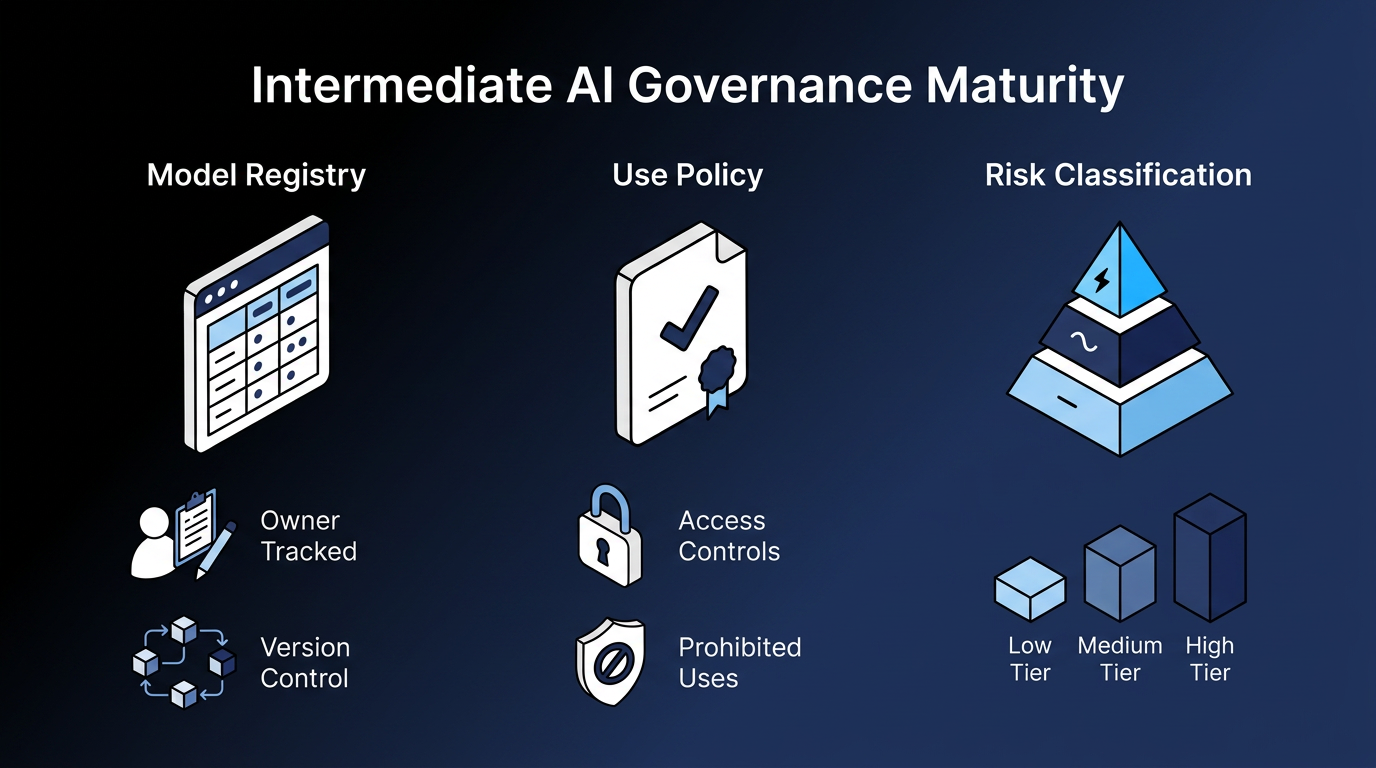
The way out of ad hoc starts by accepting that AI is already in your organization, whether or not IT deployed it. At intermediate maturity, teams catalog AI use and assign someone to own it.
The registry anchors policy and risk decisions. The controls around it make that inventory usable:
- A Central Model Registry: A living inventory of every AI system, model, and agent in use, with its business purpose, owner, and risk level. If the registry is missing, audit teams have to reconstruct ownership after an incident, when evidence is already incomplete.
- An Acceptable Use Policy: Written rules for which AI tools employees may use, with which data, for which tasks. The policy keeps employees from making tool and data decisions on their own and moving sensitive information into systems the enterprise does not govern.
- Risk Classification: A scheme that sorts systems by business risk, so a chatbot answering HR questions isn't governed like a model approving payments. Risk tiers prevent teams from over-governing low-risk tools or under-governing systems that can create real business risk.
Teams may also create an AI governance committee or an AI Center of Excellence to hold the standards. More advanced teams track model drift and data lineage. They also put governance metrics on executive dashboards. Model drift means model behavior changes as data or conditions change.
Data lineage is the record of where data came from, how it changed, and where it moved. The risk classification scheme usually maps directly to a framework tier. When a team flags a system as high-risk, the rules get stricter: it needs deeper review, more logging, and human approval. Advanced organizations reassess those classifications on a fixed schedule rather than at annual review. They also tie logging depth to the risk tier. High-risk systems capture a fuller event record. Low-risk ones stay light. But policies describe what to govern; they don't govern anything at runtime.
If a regulator asked for a complete audit trail of an AI-driven decision today, could your team produce it within a reasonable timeframe? A team that can't is still at an early maturity stage, regardless of what its written policies claim.
The Orchestrated Stage: Governance Inside Execution
At the highest maturity stage, the workflow enforces governance where AI acts: inside the workflow, at runtime, on every transaction. Policy checkpoints that live in documents can't keep pace with agents executing at machine speed. Production incidents can expose oversight failures that were invisible before deployment.
That failure pattern is why the most autonomous agents need continuous monitoring. They need enforced guardrails, human-in-the-loop checkpoints, revocable actions, and clear ownership for agent behavior.
Governed orchestration makes this enforceable. A deterministic workflow gives teams repeatable execution: the same input produces the same result every time. AI agents operate as bounded steps within it. Teams apply them only where interpretation or reasoning is genuinely needed. Humans hold human-in-the-loop checkpoints at the judgment points.
Probabilistic handoffs are workflow steps where AI may produce variable outputs. Reliability drops across them. Each probabilistic step can produce a different result. Stack too many of those steps together, and small per-step error rates can compound into unacceptable failure rates at enterprise transaction volumes. Teams sort each workflow step into deterministic and probabilistic categories. That choice determines whether governance survives scale.
In governed orchestration, AI agents run against live enterprise resource planning (ERP) data. ERP data is operational data in finance systems and supply-chain or procurement systems. The AI reasoning stays confined to the steps that need it and runs on a deterministic backbone like Elementum workflows. Every decision the agents make happens inside a governed workflow. The workflow generates the audit trail as a byproduct of execution rather than forcing teams to reconstruct it after the fact.
Reach the Orchestrated Stage of the AI Governance Maturity Model
Move now on the AI governance maturity model. Regulators are demanding human oversight and automatic record-keeping for high-risk AI systems under the EU AI Act. Boards also want AI to pay off: just 38% of CIOs rate their AI value-creation progress as excellent or good, according to Gartner. Waiting creates a backlog of ungoverned agents you'll have to retrofit later.
Elementum built its Workflow Engine for the orchestrated stage. Our Workflow Engine orchestrates AI agents inside deterministic workflows. Elementum includes integrations with OpenAI, Gemini, Anthropic, Amazon Bedrock, and Snowflake Cortex. They support configurable decision thresholds. These rules decide when an AI agent can proceed and when a human must review the work. They also support guardrails with input validation and human-in-the-loop checkpoints. Elementum logs agent actions and makes them revocable with audit trails.
Elementum uses Zero Persistence architecture to query your data where it already lives without storing a copy. We never train on, replicate, or warehouse your data.
Production workflows include software license management and provider onboarding. At Sanofi, agents built on Elementum workflows are targeting autonomous resolution of up to 80% of employee IT requests, a shift the company projects could save Sanofi's IT automation €10 million a year.
Among orchestration platforms in this category, we have the production track record for replacing legacy SaaS at enterprise scale, with named customers including Sanofi, Snowflake, Under Armour, and Elevance Health.
Contact us to map governed AI orchestration into your enterprise architecture and the rest of your AI roadmap.
FAQs About the AI Governance Maturity Model
These are the questions IT and governance leaders most often raise when they start scoring their organization against a maturity model.
How should you use an AI governance maturity model?
Use it as a staged framework for assessing how reliably your organization governs its AI. The stages run from ad hoc and undocumented through advanced and adaptive. It scores the consistency of governance practice; a policy binder alone doesn't move an organization up the stages.
How many maturity stages should your team track?
Named models use staged scales, and the exact stage count varies by framework. The work generally moves from foundational or initial governance toward optimized or advanced governance. The count matters less than picking one model and reassessing against it on a fixed schedule. That schedule matters because AI usage changes faster than annual governance reviews. Stale assessments miss systems that entered production between review cycles.
How do you assess your organization's AI governance maturity?
Start with the audit trail test: can you produce a complete record of an AI-driven decision on demand? From there, score inventory completeness, ownership assignment, risk classification, and runtime enforcement against your chosen framework. Reassess on a fixed schedule, and reassess more often if AI adoption is accelerating, so new systems do not enter production between review cycles unnoticed.
How should you compare an AI governance framework and a maturity model?
A governance framework defines what to govern: risks, controls, oversight roles, and documentation. Examples include the NIST AI Risk Management Framework and ISO/IEC 42001 for AI management systems. A maturity model measures how consistently you actually do those things. The framework sets the target; the maturity model tells you how far you are from it.