
AI Governance Platform: A Buyer's Guide for Enterprise Leaders
Your board approved AI spending. Your chief information security officer (CISO) flagged data exposure. Your CFO wants measurable returns by next quarter. Meanwhile, 69% of organizations suspect or have evidence that employees are using prohibited public generative AI tools, according to Gartner. The AI already running in your environment is moving faster than the controls meant to govern it.
That mismatch between adoption speed and governance readiness is why enterprises now buy AI governance platforms as a distinct category rather than folding governance into existing IT policy. Buyers need four things. An inventory of AI systems. Runtime policy enforcement. Audit evidence behind every decision. And a clear orchestration architecture before shortlisting.
What an AI governance platform actually does
An AI governance platform is a central control layer for every AI system your organization runs. It covers in-house systems. It also covers AI bought from vendors or embedded in SaaS products such as ServiceNow, Workday, Salesforce, and Coupa. Skip it, and you inherit the current default: ungoverned model calls, no audit trail, and compliance exposure that surfaces during an incident rather than before one.
Enterprise AI governance platforms keep AI systems aligned with responsible AI practices. They help teams enforce internal rules, regulations, and risk controls. They give teams one place to track trust, risk, and security controls, including third-party AI usage. The category has become core infrastructure because policy documents cannot enforce controls by themselves.
The category has settled around a consistent set of functions:
- Centralized AI inventory: A single record of every model and third-party AI service, including agents, tracking who owns it and what data it touches. A centralized inventory helps teams find and eliminate shadow AI, meaning AI use that has not been approved or inventoried.
- Runtime policy enforcement: Guardrails that validate against bias while enforcing data-leakage and access controls as the AI runs.
- Audit trails: A logged record of every action. Regulated-industry compliance programs rely on this evidence.
- Continuous risk monitoring: Bias detection, drift tracking, and validation that runs while systems operate. Drift tracking means watching for changes in model behavior over time, since AI risk changes with use case and context.
- Approval workflow automation: Governed routing for new AI use cases, applications, and agents before they reach production.
Enterprises that adopt these platforms are better positioned to catch AI risk before it reaches production, and to show auditors and boards that governance is systematic rather than ad hoc.
The three layers buyers confuse
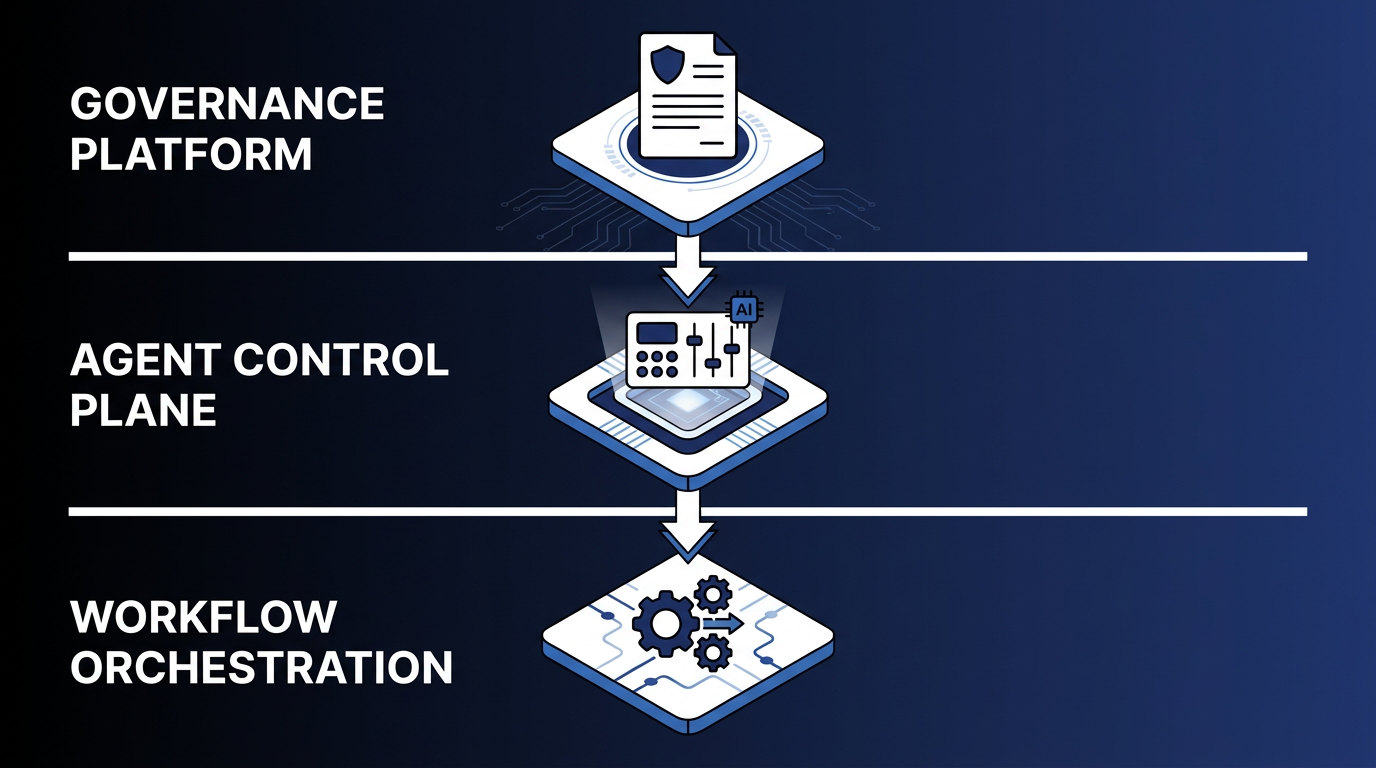
Many buyers treat AI governance as one purchase. Enterprise teams usually need three layers: governance, agent control, and workflow execution. Conflating them is how teams end up with visibility when they need execution.
An AI governance platform handles policy, compliance mapping, risk assessment, and model inventory. An agent control plane governs autonomous agents across platforms, including shadow agents running without central approval, through discovery, security posture, identity policy enforcement, and audit visibility. Workflow orchestration sequences steps, manages state, and executes the actual business process.
In this taxonomy, the agent control plane sits between governance policy and workflow execution. Governance sits outside both build and orchestration environments. Large enterprises are moving from small numbers of AI agents to agent estates, and they need controls beyond application-by-application governance.
A control plane answers "how do we govern what we're doing?" Workflow orchestration answers "what do agents and rules do at each step, and in what order?" Enterprises with both governance and process-execution requirements need both. Evaluate each layer separately: a monitoring dashboard does not execute the work.
Why deterministic orchestration is the governance backbone
The architecture underneath a governance platform shapes whether it can produce audit evidence. Many buying processes skip this distinction, and that is a mistake: it helps determine whether your AI produces an immutable trail or a probabilistic mess.
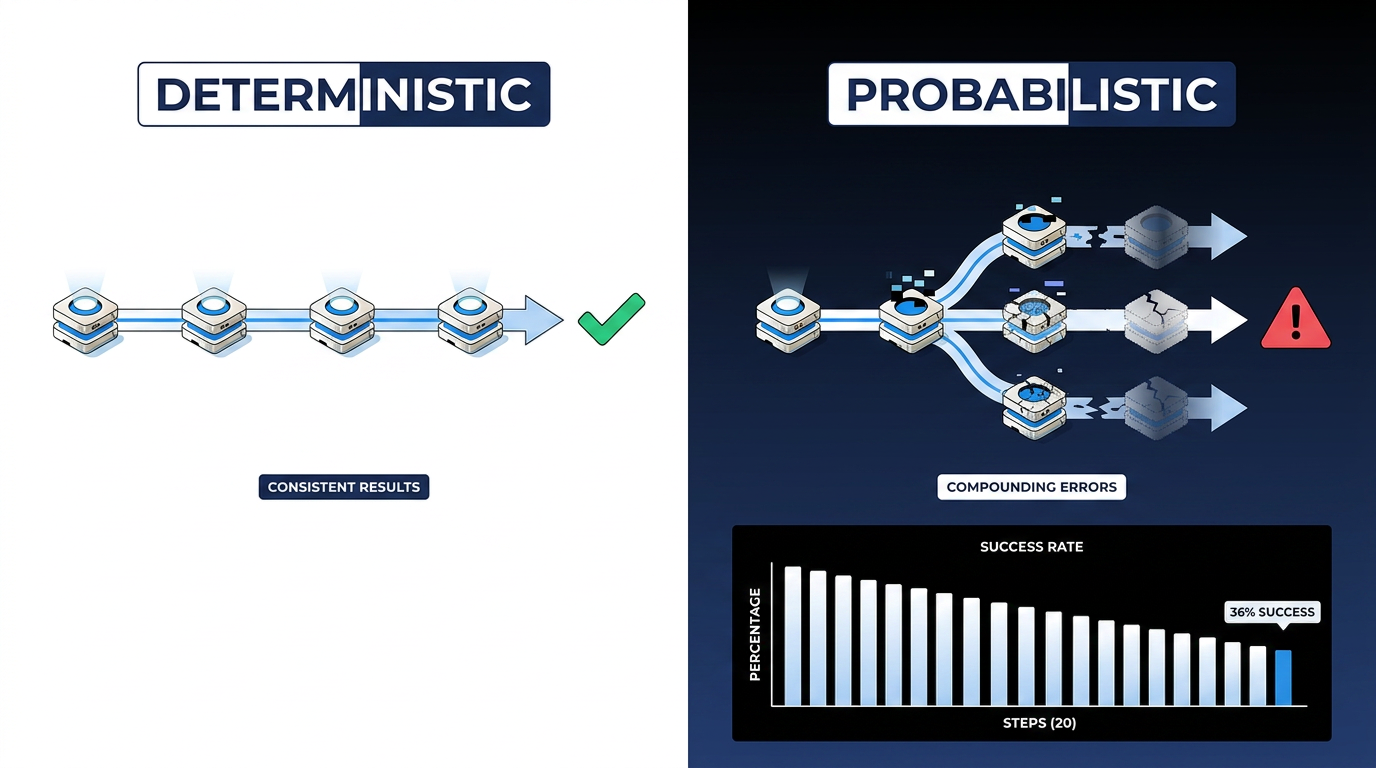
Deterministic systems encode validated logic into code, so the same input produces the same output every time. Probabilistic systems, including large language models (LLMs), generate outputs by predicting likely responses, so the same input can produce different results across runs. Workflows provide predictability and consistency for well-defined tasks. Agents fit when flexibility and model-driven decisions are needed.
When a process relies on probabilistic components, small errors can add up. Even modest per-step error rates can reduce reliability sharply across multi-step workflows, because each step treats the prior step's output as ground truth. Errors multiply rather than cancel. When an LLM orchestrates the process itself, the same inputs can produce different flows, and teams then struggle to produce the step-by-step audit trail required in banking and insurance.
A practical enterprise pattern uses deterministic orchestration as the control plane, with probabilistic AI running inside it as a bounded, governed component. In many enterprise designs, deterministic workflow engines provide the control plane, and AI is governed through configurable decision thresholds and human-in-the-loop checkpoints.
Agent-heavy workflows also multiply LLM calls and token consumption. Deterministic steps execute without model inference, so making everything agentic is both a compliance risk and a budget problem. Functions with no alternative interpretation should always be deterministic: generating a ticket ID or applying a service-level agreement (SLA) value, such as a promised response time or resolution window.
Evaluate runtime enforcement, data handling, and model portability
Vendor demos all look the same. The differences show up in architecture, contract terms, and whether policy is enforced or merely documented. Miss these, and you buy a rulebook without enforcement.
Runtime integration shows whether a platform enforces policy. Architecture and contract terms show whether that enforcement works in your environment. A policy-only platform tells you what the rules are; it lacks the technical integration to enforce them where models actually run. Use these criteria to filter:
- Third-party and agentic AI coverage: Shortlisted tools should govern agentic AI alongside traditional ML and generative AI. AI now runs across your SaaS stack, including ServiceNow, Workday, Salesforce, Coupa, and the rest. A platform that only sees homegrown models misses most of your exposure.
- Multi-framework compliance mapping: Some platforms map one control to several frameworks at once, with common mappings including the National Institute of Standards and Technology's AI Risk Management Framework (NIST AI RMF), the EU AI Act, and ISO/IEC 42001. Evidence collected once can satisfy multiple obligations. For many regulated teams, EU AI Act high-risk obligations phase in through 2026 and 2027.
- Data handling model: Ingesting data into a governance platform creates a new copy of regulated data, which expands your compliance perimeter. Query-in-place means the platform reads data where it already lives instead of copying it into a new repository, which limits data movement and reduces cross-border transfer exposure under GDPR.
- Audit attribution: A common compliance failure point appears when AI accesses regulated data under a service account, a shared technical identity used by software rather than a named employee, with no log of which individual directed the access. HIPAA, GDPR, and SOX programs all depend on accountable access trails.
- Vendor architecture and contract transparency: Two contract questions go unasked too often. Does the vendor use your data to train models, and does it store your data after the transaction? Contract language should explicitly prohibit training use and post-transaction storage if those are business requirements.
Every shortlist also needs model-agnostic architecture: a layer that can swap one model for another without redesigning the workflow. Vendor lock-in can create high switching costs, and agent-framework capture makes the problem worse, since vendor-owned orchestration layers can force your team to rebuild when you switch.
A model-agnostic layer treats the model as substitutable, giving your team room to adopt new models and negotiate on price without rewriting applications.
Why AI governance platform selection is an operational decision
AI governance now requires a near-term buying decision. Agentic AI adoption is scaling well ahead of governance maturity across the enterprise landscape, and the two are on different timelines.
Production incidents carry cost. More than 40% of agentic AI projects will be canceled by the end of 2027 due to escalating costs, unclear business value, or inadequate risk controls, according to Gartner. Prompt injection is an attack that tricks an AI system into ignoring its instructions or exposing data. It sits at the top of the LLM vulnerability list, ranked LLM01:2025 by OWASP (the Open Web Application Security Project). OWASP says there may be no foolproof prevention for prompt injection; guardrails in external systems and human review of flagged outputs are pragmatic defenses.
Sanofi offers one version of governed execution. The biopharma company built agentic workflows directly on its own data infrastructure with Elementum and Snowflake, with a goal of resolving a large chunk of employee IT support requests autonomously. Governed orchestration on owned data gave Sanofi's leaders execution they could measure, control, and expand. The alternative was agent and SaaS sprawl.
Match your AI governance platform to execution and oversight
The real decision is whether you need visibility into AI behavior or governed execution that reduces AI risk before it happens. Monitoring tells you an agent misbehaved after the fact. Orchestration constrains which steps can happen, when they happen, and when a human must review the output before it reaches production. For regulated processes where the audit trail is the deliverable, orchestration gives reviewers the evidence they need.
Elementum is an AI workflow orchestration platform. It treats humans, business rules, and AI agents as equals within deterministic workflows. Elementum's Workflow Engine provides the deterministic backbone, so the same process produces the same result every time.
We govern any third-party or native agent through configurable decision thresholds and human-in-the-loop checkpoints. We log and can revoke every action. We defend against prompt injection with built-in guardrails and input validation across every model interaction. We support compliance programs including SOX and HIPAA, with GDPR controls built in. Your data is always yours: we never train on, replicate, or warehouse your data.
Many of our customers start with one workflow, prove the savings, and expand into adjacent processes.
Among orchestration platforms in this category, we have the production track record for replacing legacy SaaS at enterprise scale, with named customers including Sanofi, Snowflake, Under Armour, and Elevance Health.
Contact us to map governed AI orchestration into your enterprise architecture and the rest of your AI roadmap.
Frequently asked questions
These are the questions IT and security leaders most often raise when evaluating AI governance platforms.
What is an AI governance platform?
An AI governance platform is software that lets organizations monitor, manage, and enforce policies across every AI system in use. That includes systems built internally, bought from vendors, embedded in SaaS products, or accessed through third-party integrations such as ServiceNow, Workday, Salesforce, and Coupa. Core functions include a centralized AI inventory, runtime policy enforcement, audit trails, and continuous risk monitoring across traditional ML and newer generative or agentic AI systems.
How much should you expect an AI governance platform to cost?
Pricing varies widely by scope and maturity. Mid-market deployments and large regulated-enterprise programs differ significantly. Enterprise platforms often require significant annual commitments rather than one-time purchases. Budget planning should account for governance platforms becoming part of how the business runs, not just policy-planning tools.
How should you distinguish AI governance from AI agent management?
AI governance covers policy, risk, compliance, inventory, and evidence across AI systems. AI agent management adds authority controls for agent actions: what the agent may do, whose identity it acts under, and when a human must approve the step. They require different frameworks and are often bought as separate layers.
Which regulations should your AI governance platform support?
The most common requirements are the EU AI Act, GDPR, CCPA, NIST AI RMF, and ISO/IEC 42001, plus sector rules like HIPAA and SOX. EU AI Act obligations and penalties make multi-framework mapping something organizations need soon when they deploy AI in regulated or high-risk contexts.
Who should own AI governance inside your enterprise?
Effective governance requires coordination across IT, business, security, and compliance leaders. Accountability still depends on a single role holding authority over AI governance. Security teams need a central role because they own identity and access controls as well as logging and incident response. Programs weaken when individual application owners make governance decisions without that shared control layer.